Selection Guide
How to Select the Right KR / KRV Cam Follower
Start with the interface you cannot change: roller outside diameter, roller width, stud diameter and thread. Then check the track or cam surface, support for the stud, speed/cycle rate and the operating environment.
If the mechanism needs clearance adjustment, ask whether an eccentric KRE/KRVE execution is appropriate. If the existing track is worn or misaligned, replacing the bearing alone may not restore the intended contact pattern.
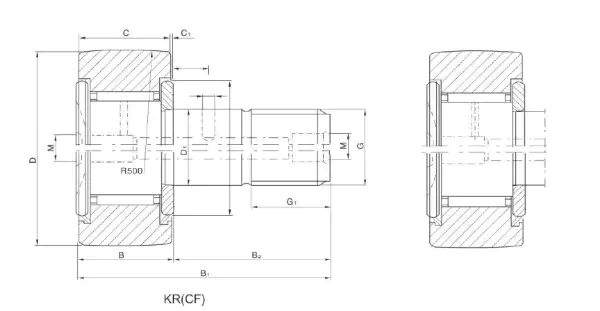
Selection Sequence
| Step | Decision | Evidence to collect |
|---|---|---|
| 1 | Identify the existing part | Model marking, machine manual, photo. |
| 2 | Measure the fixed interface | D, C, stud diameter, thread pitch, available length. |
| 3 | Check the track | Width, alignment, running-surface profile, visible wear. |
| 4 | Define duty | Load direction, speed/cycles, shock, contamination, temperature. |
| 5 | Define service | Lubrication access, sealing, clean-environment or material restrictions. |
| 6 | Confirm variant | Standard vs eccentric; any special material or documentation. |
KR vs KRV and Outer-Ring Profile
The KR/KRV specification table pairs KR and KRV designations at each size and notes that the outer surface can be cylindrical or spherical depending on design. Because naming conventions vary by maker and suffix, verify the actual profile on the existing part and drawing instead of assuming it from the family name alone.
Load and Speed Data
The specification provides basic-load-rating values C and C0 plus limiting speed in rpm. The load-rating unit is not printed in that table. Keep the numerical values as a comparison reference, but confirm the unit convention and full calculation method before using them for life or safety calculations.
Send your dimensions for selection support
Send the model, quantity, mating-track details and application notes for a quotation review.