Cam Follower Bearings for Industrial Robots and Automation Systems
cam follower for industrial robot / stud type bearing automation
Automation equipment often needs compact rollers in cam paths, transfer units, grippers, indexing fixtures and linear modules. These are usually auxiliary motion elements rather than the main robot-joint bearing. Space is limited, cycle counts can be high and the stud may be difficult to reach after assembly, so the mounting interface and service plan deserve early attention.
EP-KR13, EP-KR16, EP-KR19 and EP-KR22 are useful compact references for small mechanisms when their dimensions match the design. If the assembly is close to sensors, optics or a cleaner process zone, specify the required seal and grease execution instead of assuming a standard industrial configuration.

Typical Mechanisms
Cartesian and SCARA Auxiliary Motion
Compact cam or track guidance in secondary axes, transfer modules and end-of-arm mechanisms.
Indexing Fixtures
Repeated positioning in assembly stations where track condition and mounting stiffness influence repeatability.
Grippers and Tool-Changing Modules
Small cam-driven mechanisms with tight packaging around the stud and roller.
Automated Transfer Units
Track-guided motion in pick-and-place, feeding and part-transfer systems.
What to Check Before Selecting
| Selection check | Why it matters |
|---|---|
| Envelope and stud access | Automation frames can leave little wrench clearance or room for a long stud projection. |
| Cycle frequency and reversal | Repeated short strokes can make lubrication condition and local track wear more important than a single peak-speed number. |
| Mounting rigidity and track finish | Repeatable motion depends on the surrounding structure as well as the bearing dimensions. |
| Cleanliness and grease control | State any low-particle, controlled-grease or sealing requirement in the order specification. |
Recommended Size References
EP-KR13 / EP-KR16 / EP-KR19 / EP-KR22 are compact catalogue references for automation and robot auxiliary mechanisms. Match the measured D, C and stud thread first; larger models can be reviewed when the track and available mounting space require them.
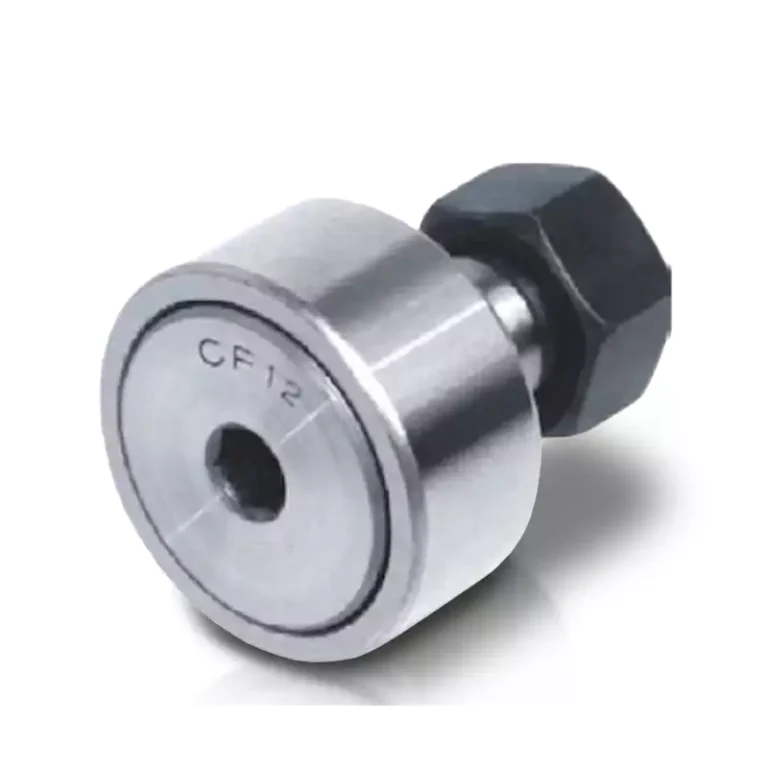
EP-KR13 Cam Follower Bearing | CF5 Cross Reference | Stud Type
EP-KR13 stud type cam follower bearing with 13 mm outside diameter, M5 x 0.8 metric stud thread and CF5 cross-reference designation.
View specificationsEP-KR16 Cam Follower Bearing | CF6 Cross Reference | Needle Roller
EP-KR16 stud type cam follower bearing with 16 mm outside diameter, M6 x 1 metric stud thread and CF6 cross-reference designation.
View specificationsEP-KR19 Stud Type Cam Follower | CF8 Cross Reference
EP-KR19 stud type cam follower bearing with 19 mm outside diameter, M8 x 1.25 metric stud thread and CF8 cross-reference designation.
View specificationsEP-KR22 Cam Follower Bearing | CF10 Metric Stud Type
EP-KR22 stud type cam follower bearing with 22 mm outside diameter, M10 x 1.25 metric stud thread and CF10 cross-reference designation.
View specificationsIntegration and Service in Automation
Plan how the stud will be tightened and inspected after the surrounding guards, cables and sensors are installed. A follower that is easy to fit on the bench can become difficult to service once it is inside a compact cell.
Inspect the old contact pattern when replacing an existing follower. Edge wear or a polished strip that is off-centre can indicate track alignment or structural deflection, and replacing only the roller may not remove the underlying cause.
Application FAQ
Are EP-KR13 to EP-KR22 only for robots?
No. They are compact size references. They can be considered for many automation mechanisms when the measured interface and duty match.
Do clean automation applications require a special execution?
They may. If grease migration, particles or nearby sensors are a concern, specify the required sealing, grease and material controls with the enquiry.
Discuss this application with EVER POWER
Send the existing model, measured roller diameter and stud thread, quantity, track details and operating notes for a quotation review.